


 Find additional Shakespeareances
The Two Gentlemen of Verona
The Two Jerks of Verona in Milan
American Shakespeare Center, Blackfriars Playhouse, Staunton, Virginia
Saturday, September 20, 2025, C–5 (center stalls)
Directed by Aidan O'Reilly
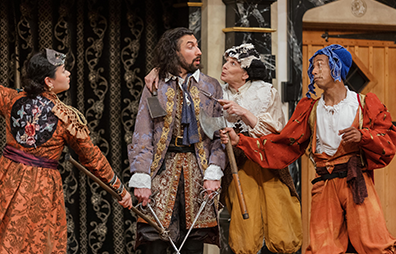
Joe Mucciolo as Valentine, second from left, is taken by the outlaws—from left, Isabel Sanchez with what looks like a backscratcher, Angela Iannone with a cleaver and carving fork, and Geoffrey Warren Barnes II with a hatchet—in the American Shakespeare Center production of William Shakespeare's The Two Gentlemen of Verona at the Blackfriars Playhouse in Staunton,Virginia. Phot by Lindsey Walters
"Aidan O'Reilly as Clarence calmly debating with his murderers," I wrote in my review of the American Shakespeare Center's 2012 production of William Shakespeare's Richard III at the Blackfriars Playhouse. It's one of many indelible memories O'Reilly has provided over the years, all the way through his Player King's speech in 2023's Hamlet at the Blackfriars. In that Hamlet, he created the production's highlight moment with his determined intention to be superglued to the text. He emoted only in his face and the words flowing from his mouth. He was mesmerizing.
O'Reilly has always had a no-nonsense, speak-the-text-as-is approach to Shakespeare, and he brings that approach when directing one of Shakespeare's most problematic plays, The Two Gentlemen of Verona. It's categorized as a romantic comedy, but productions strive hard to make the play's bizarre ending make comic sense for any human watching it as Proteus tries to rape Valentine's girlfriend, Silvia; whereupon Valentine, after rescuing Silvia and hearing Proteus's repentance, offers Silvia to Proteus; whereupon Proteus's girlfriend, the disguised-as-a-boy Julia, reveals herself; whereupon Proteus remembers his true love for Julia; whereupon the two reunited couples—Valentine and Silvia, Proteus and Julia—head off stage presumably to their matrimonies. I've seen myriad ways theaters try to achieve a happyish ending by manipulating the lines and, particularly, Silvia's silence: though present, she speaks nothing for the last 113 lines of the play.
A solution becomes obvious in O'Reilly's staging of the play—the entire play, not just the ending, and thereby making that ending less problematic. Taking the text at face value, this play is a romantic comedy without a romantic ending because Valentine and Proteus are jerks. They always have been, if you've been paying attention. In this reading, Silvia's silence would have been salient in the time of the play's early 1590s composition when Queen Elizabeth reined. It definitely works in 2025 because what can you say to such a supposed boyfriend as Valentine? Nothing worthwhile, so you ghost him.
The Two Gentlemen of Verona was the first Shakespeare play O'Reilly ever saw. He was 8 years old, and he admits the play has always had an emotional tug on his heart. In his director's notes, he remarks how Shakespeare is portraying growing into an adult as much as he is describing young love. "What's it like to leave home for the first time, when your friends are more important to you than family, and romance is all you want but you're also not entirely certain what romance really is?" O'Reilly writes. "Innocence can be dangerous when it's holding hands with ignorance, but maybe love can show you a better way if you don't get caught up trying to be somebody else." He concludes by quoting a Samuel Beckett line as his north star for this production: "Paths look different when you walk back along them."
His actors seem to have started with the play's ending and worked back through to the roots of their characters' journeys in playing the titular two gentlemen, Valentine (Joe Mucciolo) and Proteus (understudy Pete Sheldon, showing great depth filling in for Britt Michael Gordon). When we meet them, the childhood friends are parting, Valentine to find mentorship in the Duke of Milan's court, Proteus remaining in Verona to consummate his crush on Julia. It's 62 lines of Valentine ridiculing Proteus about his being a wuss so devoted to romance, and Proteus defending himself with riddling metaphors on love. It's a spectacle of one-upmanship that results in the drawing of swords, though after Valentine easily disarms Proteus, they part as best buds forever. I've never seen the scene played with such arrogance before. And thus they continue, Proteus trying to woo Julia (Sara Linares) through letters, and Valentine becoming besotted with the Milan Duke's daughter, Silvia (Maya Danks).
A keen decision was to dress the play in mid-17th century Cavalier fashion, the age of the Three Musketeers. Such clothing (gorgeously rendered by costume designer Elizabeth Wislar) immediately signals a cavalier (duh!) attitude among the men and instant identities of their youth, bravado, romance (a la Cyrano de Bergerac), and best buddy bonds often at opposition to honest romance.
Sheldon plays Proteus's infatuation with Julia in earnest, but his naivete is obvious, too. More interesting is Mucciolo's portrayal of the self-assured Valentine's naivete in Milan. He's clearly smitten with Silvia but doesn't recognize how obviously she is chasing him. Standing in the upper gallery, Silvia strategizes as she waits for Valentine to walk below her and drop her glove as he passes. Then she pulls the trick of having Valentine write a love letter to the man of her affections and gives it right back to him proclaiming she has delivered it. Danks's brimming enthusiasm combined with her keen intelligence makes this an "excellent device" indeed, as noted by Valentine's quick-witted servant, Speed (Isabel Lee Roden), and Silvia delights in Valentine's unconceiving confusion. In my experience, this scene usually channels the comedy through Valentine's stupidity; Mucciolo's portrayal, however, is one of a man who can't think outside his self-perspective, and it's still funny.
When Proteus is forced by his father to join Valentine in Milan and he instantly crushes on Silvia, Sheldon plays the moment subtly. We don't see his crush toward Silvia; rather, we see his sudden maturity toward Valentine, especially in the face of Valentine so blatantly insulting Julia with comparisons to Silvia. To be sure, Proteus has been silently doing his own comparing of Juliet and Silvia, but Valentine's insults provide additional motive to Proteus's recharged romantic ambition. As played here, the seeds of his willingness to dismiss his cavalier fealty to Valentine are clearly planted in this scene.
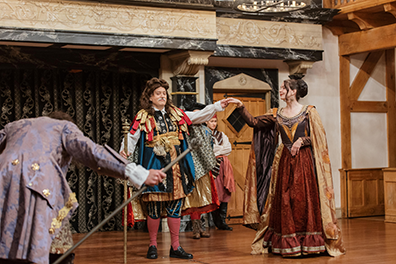
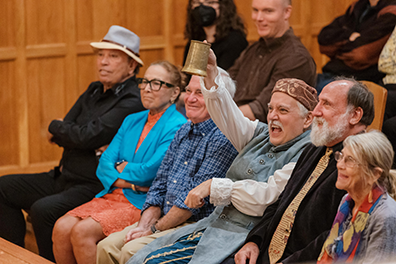
The many places of Christopher Seiler in the American Shakespeare Center production of William Shakespeare's The Two Gentlemen of Verona at the Blackfriars Playhouse. Above, Seiler as the Duke of Milan introduces his daughter Silvia (Maya Danks) to his court. Below, Seiler as the host of the inn hangs with the Blackfriars audience as he shouts a toast to Proteus's music. Photos by Lindsey Walters.
Proteus's first soliloquy is purely focused on Silvia versus Julia. He expresses surprise at his sudden change of heart from Julia to Silvia: "Is it mine eye, or Valentine's praise, her true perfection, or my false transgression that makes me reasonless to reason thus?" To court Silvia perforce means dismissing his friendship with Valentine, and he addresses that on the moral grounds of betraying his friend. And his girlfriend, too, but "now," he says, "my love is thawed." He says the like of his friend. "Methinks my zeal to Valentine is cold, and that I love him not as I was wont. O, but I love his lady too too much, and that's the reason I love him so little." Proteus doesn't parse the difference between lust and love—especially as Danks' Silvia is obviously so into Valentine she shows no particular favor toward Proteus except that he is her lover's best friend. Yet, to Sheldon's Proteus, winning Silvia is a given. Arrogance or ignorance? Both.
The skills with which Sheldon over the course of his two soliloquies concludes to betray his friend and his girlfriend to pursue Silvia are reflected in the audience's reactions. It starts with notable physical agitation in the patrons around me. Groans start to sound, and even a few catcalls. By the time Sheldon's Proteus concludes that "I to myself am dearer than a friend" and that "I will forget that Julia is alive, remembering that my love to her is dead," he hears boos. Julia, meanwhile, now disguised as a boy in order to follow Proteus to Milan, gets audible compassion from the audience as she watches her boyfriend betraying her in his pursuit of a woman who wants nothing to do with him. Proteus giving the disguised Julia the ring she gave him upon their parting—which he now wants her to present as his gift to Sylvia—inspires a significant uproar in the audience.
O'Reilly inserts some nice staging moments derived from his long experience on this stage. When Proteus courts Silvia with song, Sheldon performs "Let it be Silvia" in Elvis mode. Why not? Worked for Elvis. As Silvia comes onto the balcony and berates him, Proteus doesn't turn toward her but plays and speaks to the back of the house, allowing us to see his reaction to her railing at him. That reaction is, wait for it, clueless. Julia, meanwhile, is sitting in the audience speaking her asides to them.
When we get to the final, troublesome scene, the established self-indulgent attitudes of the two men dictate how the action plays out. In rescuing Silvia from Proteus's threat of raping her, Valentine disarms his onetime friend with the same move he used in the opening scene. Valentine is again the alpha cavalier, and Proteus grovels in his presence, whereupon Silvia angrily shakes her head at Proteus's disingenuous genuflection. But Proteus's act is nothing compared to her betrothed's speech starting with, "Then I am paid, and once again I do receive thee honest"—huh?! is Sylvia's reaction—and ending with "And that my love may appear plain and free, all that was mine in Silvia I give thee." Danks delivers the most incredulous WTF glare I've ever seen. Indeed, her anger deepens with Jullia's reveal and Proteus immediately going back to her. Then comes Thurio (Nick Ericksen playing him with flamboyant cowardice) giving her over so easily—she can't stand him, but still—followed by her father's endorsement of Valentine as her husband.
ASIDE: The Dog is Himself
The American Shakespeare Center and its predecessor, the traveling Shenandoah Shakespeare Express, has long been a breeding ground for great Shakespearean actors. That includes dogs, too. Real dogs.
The company has a history of partnering with local pet adoption centers in casting the character of Crab. Launce's dog in The Two Gentlemen of Verona. Even when the company's 2016–2017 Hungry Hearts Tour played Two Gents across the country, it partnered with local adoption programs for a guest star to play Crab.
Last season, the American Shakespeare Center is using "adoptable stars" from local dog adoption agencies like Friends of Staunton August Waynesboro Animal Shelter.
Whoever is playing Crab in each performance is introduced by Launce (Geoffrey Warren Barnes II) during the pre-show announcements. A page in the play program offers a QR code to check out current and future Blackfriars Playhouse stars. "Cats are in the wings, too, even if Shakespeare forgot to write them in," notes the advertisement.
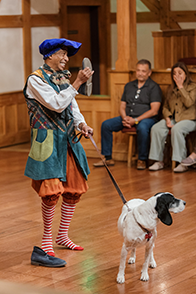 These actors bring a truthfulness to their performances that a human in a costume can never fully attain. Crab has found good friends among the patrons sitting on the gallant stools lining the sides of the stage.
Then there was Tulip, a mixed-breed from the Augusta (County) Dog Adoptions, in the 2012 Blackfriars production. Tulip seemed uncomfortable in her star turn and, unrehearsed as she was, forced Benjamin Curns playing Launce to react to her. Curns brought all of his Shakespearean improv skills to the role. When Launce described Crab's behavior in the dining room and how he, Launce, took the blame, Curns directly asked Tulip, "How many masters would do this for his servant?" Tulip grew skittish, perhaps reacting to Curns' tone. The audience responded with variations on the interjection "awww," but Curns' Launce would have none of it. "Nay," he said turning on the audience: "I'll be sworn I have sat in the stocks for puddings he hath stolen, otherwise he had been executed." What a perfect response in that particular live moment—and yet, it's right there in Shakespeare's 535-year-old text.
These actors bring a truthfulness to their performances that a human in a costume can never fully attain. Crab has found good friends among the patrons sitting on the gallant stools lining the sides of the stage.
Then there was Tulip, a mixed-breed from the Augusta (County) Dog Adoptions, in the 2012 Blackfriars production. Tulip seemed uncomfortable in her star turn and, unrehearsed as she was, forced Benjamin Curns playing Launce to react to her. Curns brought all of his Shakespearean improv skills to the role. When Launce described Crab's behavior in the dining room and how he, Launce, took the blame, Curns directly asked Tulip, "How many masters would do this for his servant?" Tulip grew skittish, perhaps reacting to Curns' tone. The audience responded with variations on the interjection "awww," but Curns' Launce would have none of it. "Nay," he said turning on the audience: "I'll be sworn I have sat in the stocks for puddings he hath stolen, otherwise he had been executed." What a perfect response in that particular live moment—and yet, it's right there in Shakespeare's 535-year-old text.
The Blackfriars Playhouse is the world's only re-creation of Shakespeare's indoor theater, and the American Shakespeare Center is committed to original production practices. In that vein, such experiences as Curns had with Tulip lend credence to a theory that the original Launce, Will Kemp, infamous for his improvisational skills, also used a real dog in the part. —EM
Above: Geoffrey Warren Barnes II as Launce with Crab at the American Shakespeare Center's Blackfriars Playhouse. Photo by Lindsey Walters.
Men!!!! What can you do in the company of such assholes, chief among them your betrothed. Sure, Silvia is a Duke's daughter and truly a mesmerizing beauty, and she might be vain, but she's not dumb. As Valentine reaches for her, Danks's Silvia executes the most emphatic F-you exit the Blackfriars has ever seen. And Juliet? She does, too. Valentine and Proteus are surprised—they sure didn't see that reaction coming from their girlfriends. But, oh well, the two men shrug and stumble into each other as they try to leave together. It is the happiest ending this play deserves: the two women were saved from being married two these two jerks, the two guys will be just fine in their clueless attitudes, and I've now finally seen a production that showcases Shakespeare's skills in weaving such astute character development through this early work of his.
Yet, The Two Gentlemen of Verona has maintained a stage presence for more than 400 years on the strengths of its many comic strands. This production expands on those strands with the casting of Christopher Seiler as the Duke, subversively funny in his portrayal of egomaniacal governance; and Angela Iannone as Julia's maid, Lucetta, using a guttural Italian accent and earning laughs from her ever-stoic attitude while doing and saying silly things. Roden expertly manages Speed's linguistic-based humor, especially in her one-on-one scenes with Mucciolo's head-in-his-clouds Valentine. The Outlaws who set upon Valentine and Speed after their banishment from Milan can't help being funny. Isabel Sanchez, Iannone, and Geoffrey Warren Barnes II adhere to their bandits' textual thematic purpose, calling themselves "gentlemen, such as the fury of ungoverned youth thrust from the company of awful men." One was banished for "practicing to steal away a lady, an heir, and near allied unto the Duke" (exactly why Valentine was banished), one for "in my mood, stabbing a gentleman unto the heart," and others for "suchlike petty crimes as these." Cavaliers all, even if Iannone's Outlaw has a cleaver and carving fork for her weapons, though she wields them well.
Aside from playing a bandit, Barnes takes on one of the great comic characters in theater history, Launce, which provides actors the greatest challenge in theater history: out-acting a dog. In this production, Crab the dog is variously played by residents of the Friends of Staunton Augusta Waynesboro Animal Shelter auditioning for adoption by a smitten patron. Barnes not only handles both a real four-legged Crab and Shakespeare's obtuse jokes with aplomb, he himself portrays Launce with the attitude of a dog like Crab, who is loyal but just can't help himself when he has an opportunity to steal Silvia's "capon's leg" from her trencher, or when he joins the company of "three or four gentlemanlike dogs under the duke's table" for a "pissing while" and all the chamber smelt him.
Maybe that's part of Shakespeare's thematic arc of this play: there's not much difference in the behaviors of Crab, Valentine, Proteus, Thurio, the Duke, and the Outlaws. Men!!!!
Eric Minton
March 3, 2026
Comment: e-mail editorial@shakespeareances.com.
Start a discussion in the Bardroom
